

Table of Contents
A BIM outsourcing vendor that’s excellent for a US design firm needing live coordination-call overlap can be the wrong fit for a Dubai contractor needing GCC authority-standard familiarity, and both are different again from an APAC operation scaling a 40-modeler team for a six-month sprint. Region changes which vendors make sense, because it changes the constraints that actually matter: time-zone overlap, local code and standards knowledge, labor cost structure, and volume-scaling capacity. This guide breaks down real, currently operating BIM outsourcing companies by region, with the specific criteria that separate a genuinely good fit from a directory listing.
Why Region Matters When Outsourcing BIM Work
Most “best BIM outsourcing company” roundups treat the whole world as one market. It isn’t.
Time zones determine whether you get live coordination a US-based team working with a 9.5-to-12-hour offset from India or the Philippines gets asynchronous handoffs, not real-time clash meetings, unless the vendor deliberately staffs a shifted or overlapping shift. A vendor in Eastern Europe or Latin America, by contrast, can offer several hours of live overlap with US business hours.
Code and standards familiarity matters most for the Middle East, where GCC authority submission requirements (Dubai Municipality, Abu Dhabi’s DMT, Estidama, and country-specific green building codes like QSAS in Qatar) sit alongside international standards like ISO 19650. A vendor without direct GCC submission experience will burn weeks relearning local approval workflows on your dime.
Labor cost structure and volume-scaling capacity dominate the APAC calculation. Firms in India, the Philippines, and Vietnam can typically flex a team from a handful of modelers to dozens within weeks — useful for firms with lumpy, project-based demand rather than steady year-round work.
Language and communication style cut across all three regions but show up differently: APAC vendors serving Western clients need demonstrated English fluency in technical documentation, not just spoken English; Middle East vendors often need Arabic-English bilingual capability for authority correspondence.
How We Evaluated These Companies
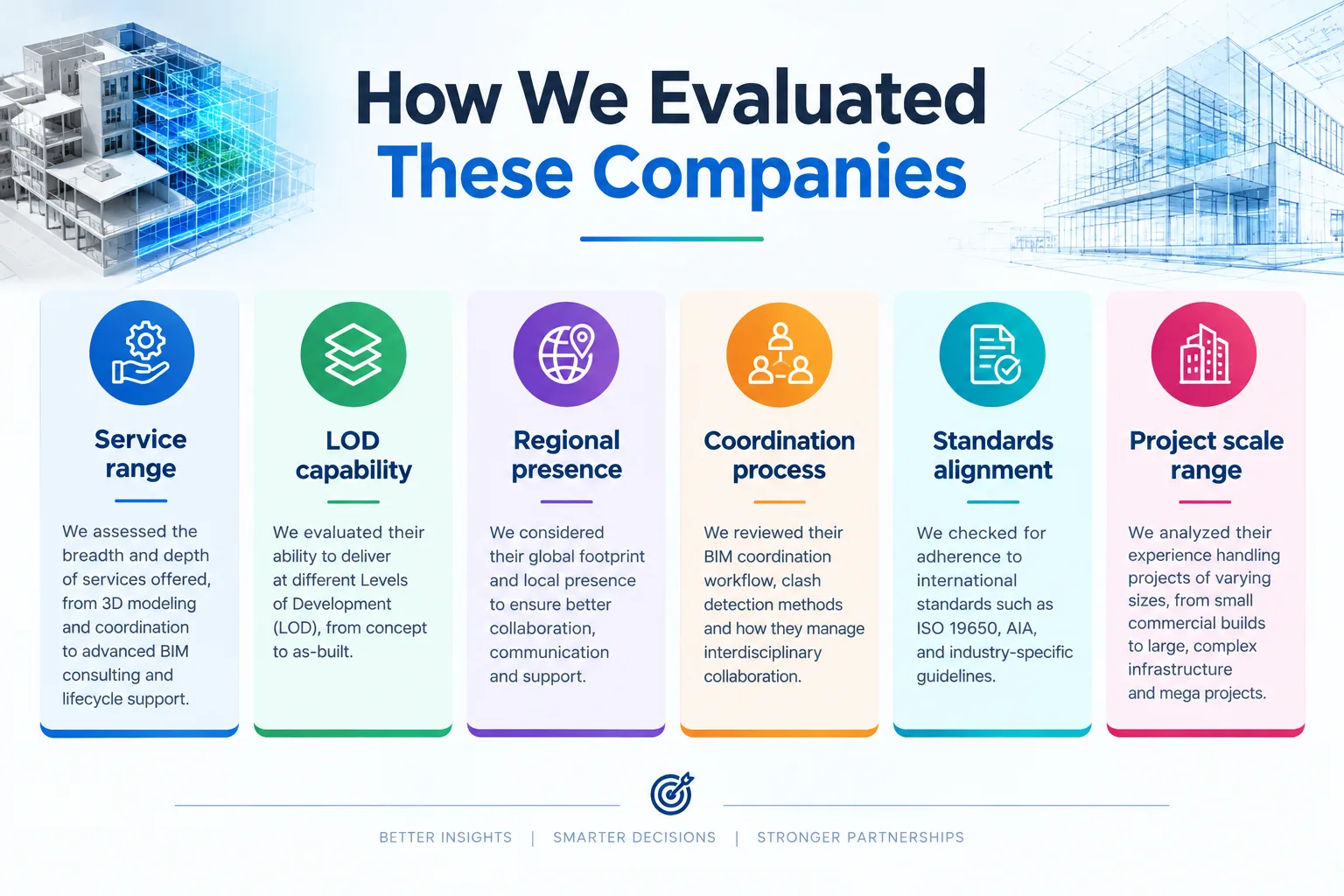
Most listicles score vendors on vague criteria like “quality” and “communication.” That tells you nothing you can act on. Here’s what we actually checked for each company below, based on public information about services offered, regions served, and stated experience not on invented benchmarks:
- Service range: whether the vendor covers architectural, structural, and MEP modeling, or specializes in one discipline
- LOD capability: whether they state clear Level of Development ranges (LOD 100–500) rather than vague “high-detail modeling” language
- Regional presence: physical offices or stated project delivery history in the specific region, not just a marketing page targeting that region’s search terms
- Coordination process: whether clash detection, CDE-based collaboration, and multi-discipline coordination are named services, not implied
- Standards alignment: explicit reference to ISO 19650 or region-specific codes (LEED, Estidama, QSAS) where relevant
- Project scale range: evidence of handling both small and large projects, or a stated specialization at one end
None of the companies below were scored on unverifiable claims like exact client counts or awards where a company’s marketing made such claims without third-party confirmation, we left those specifics out.
Best BIM Outsourcing Companies for USA-Based Projects
BluEnt operates as a US-headquartered BIM outsourcing partner with delivery capacity spanning LOD 100 through LOD 500, working inside client Revit environments and attending client coordination meetings directly. It’s positioned as a back-end production partner for firms that want to plug an outsourced team into their existing workflow rather than manage a separate offshore process. Best fit: US architecture and engineering firms that want the outsourced team to function like an extension of their internal department.
Pinnacle Infotech is one of the longer-established names in BIM outsourcing, with a global delivery footprint and services spanning 3D modeling, clash detection, 4D/5D BIM, and ISO 19650-aligned project setup including BIM execution plan support. Best fit: US firms running larger, standards-heavy projects that need a vendor already fluent in ISO 19650 documentation, not just modeling production.
Powerkh is a UK-based company with offices in the USA and Ukraine, offering LOD 100–500 modeling, BIM coordination, Scan to BIM, and BIM automation using scripting and generative design. The multi-country office structure gives it more time-zone flexibility than a single-region shop. Best fit: US firms wanting an outsourcing partner with a European base that can offer broader overlap hours than a purely Asia-based vendor.
Clove Technologies covers commercial, residential, industrial, infrastructure, and institutional project types with services across BIM modeling, Scan to BIM, MEP coordination, clash detection, and digital twins. Best fit: US firms with mixed project types who want one vendor covering multiple sectors rather than a specialist.
For firms evaluating BIM services in USA specifically, that’s another option worth putting through the same evaluation criteria above regional presence, LOD range, and coordination process, checked against your actual project needs rather than taken on the strength of the sales page alone.
Best BIM Outsourcing Companies for Middle East Projects
QeCAD positions itself explicitly around UAE and Saudi authority standards, stating direct experience delivering drawings aligned with UAE authority requirements and international codes across residential, commercial, mixed-use, hospitality, healthcare, and infrastructure sectors. Best fit: UAE and Saudi firms that need a vendor already conversant in local authority submission requirements, not just BIM modeling generally.
Engisoft has operated in the Dubai BIM services market for close to two decades, offering architectural, structural, and MEP BIM services along with 3D coordination, clash detection, and facility management model delivery up to LOD 500. Best fit: GCC-based firms wanting a vendor with a long regional track record specifically in Dubai and Abu Dhabi delivery.
AEODC covers Revit architecture modeling, MEP modeling, clash detection, structural 3D modeling, and construction document set preparation specifically across UAE, Saudi Arabia, Qatar, and the wider Middle East. Best fit: EPC contractors and MEP consultants needing coordination-heavy support across multiple GCC countries under one vendor.
Bim Craft Solutions serves the Dubai and broader GCC market with a service range spanning 3D modeling, 4D/5D simulation, structural engineering, MEP design, and digital prefabrication. Best fit: developers running large-scale GCC projects who want simulation and prefabrication support bundled with core modeling, rather than sourcing those separately.
Best BIM Outsourcing Companies for APAC Projects
IDC International Design Consultancy is a Ho Chi Minh City-based architectural firm with several decades of industry experience and roughly two decades specifically in outsourcing, offering BIM and digital services for large-scale international projects. Best fit: firms wanting an APAC vendor with deep architectural-design roots, not just production modeling.
CS Global Group operates as a Southeast Asian construction IT solutions provider supporting Integrated Digital Delivery workflows, with services spanning 3D modeling, project scheduling, and cloud-based collaboration tools including Autodesk BIM Collaborate Pro. Best fit: firms that want a vendor comfortable working inside cloud-based CDE platforms rather than file-transfer workflows.
Silicon Engineering Consultants has over a decade of experience delivering BIM services across the Philippines and internationally, covering the full range from 3D through 7D BIM services including Scan to BIM conversion. Best fit: firms needing a vendor that can scale from pure modeling into cost and lifecycle data services on the same engagement.
Hitech CADD Services operates as an India-based outsourcing provider delivering architectural BIM services internationally, positioned as a production partner for firms looking to offload modeling and drafting volume. Best fit: firms prioritizing cost-efficient production scaling for high-volume, lower-complexity modeling work.
Comparison Table: Regional Outsourcing Snapshot
Region | Typical Cost Structure | Time Zone Overlap (with US Eastern) | Best For |
USA-based vendors | Higher than offshore, lower than in-house hires | Full overlap | Live coordination calls, tight-turnaround RFI response, standards-sensitive projects |
Middle East vendors | Mid-range, varies by country | Little to no overlap with US hours; strong overlap with European/GCC hours | GCC authority submissions, local code compliance, projects requiring Arabic-English coordination |
APAC vendors | Generally the lowest cost per modeling hour | Minimal live overlap with US hours; typically handled via asynchronous handoff or shifted shifts | High-volume modeling, cost-sensitive projects, teams that can work on a 24-hour production handoff model |
How to Choose the Right BIM Outsourcing Partner — Step-by-Step
- Define the actual BIM uses you need, not just “BIM services.” Clash detection is a different capability from 4D scheduling, which is different again from COBie-ready FM data. Vague scoping produces vague vendor matches.
- Request a sample model at the LOD your project actually needs. Don’t accept a generic portfolio render — ask for a model segment at LOD 300 or 350 relevant to your discipline, and check element-level data completeness, not just visual polish.
- Test turnaround on a real RFI-driven update, if possible, before signing a full contract. A vendor’s stated turnaround time means little until you’ve seen how fast they actually revise a model after a design change request.
- Confirm live overlap hours in writing, not just “we’re flexible.” Ask specifically which hours their team is staffed for real-time coordination calls in your time zone.
- Check standards fluency directly. For ISO 19650 projects, ask the vendor to walk through how they’d structure a CDE and naming convention for your specific project — a canned answer versus a specific one tells you a lot.
- Start with a bounded pilot project, not a full-scope engagement, when working with a new vendor for the first time. A single building or a single discipline scope lets you evaluate quality and process before committing further volume.
- Confirm data security and IP handling terms before sharing project files — this matters more with offshore vendors handling client-confidential design data across borders.
Common Mistakes Companies Make When Outsourcing BIM Work
Choosing purely on hourly rate. The lowest quoted rate often reflects lower discipline coverage or less coordination experience, not just leaner overhead. A vendor that requires three rounds of revision to get a clash-free model costs more in project delays than the rate difference saved upfront.
Not defining LOD requirements before the engagement starts. “High-quality modeling” means nothing operationally. Without an agreed LOD target per stage, you’ll get models that are either over-detailed (wasted hours) or under-detailed (unusable for the intended purpose) relative to what you actually needed.
Assuming all APAC or Middle East vendors are interchangeable within their region. A GCC vendor experienced in Dubai authority submissions may have no Saudi-specific experience, and vice versa — the regulatory environments differ by country even within the same region.
Skipping a written communication protocol. Time-zone-separated teams need a defined cadence for updates, escalation paths for urgent clashes, and a single point of contact — without this, issues sit unresolved for a full day-cycle before anyone notices.
Treating the first engagement as a full-scope commitment. Firms that jump straight into a multi-building, multi-year contract with an unproven vendor take on far more risk than firms that pilot on one discipline or one building first.
Next Step
Pick one discipline for your next project architectural coordination, MEP clash detection, or scan-to-BIM conversion and run it as a pilot with one vendor from the region that matches your actual constraints (time zone, standards, or cost). Judge the fit on that single scope before deciding whether to expand the relationship.
FAQ's
Start by defining the specific BIM uses you need — modeling, clash detection, 4D/5D, or FM data — then request a sample model at your actual required LOD, confirm live coordination overlap hours, and pilot on a bounded project before committing to full scope.
For firms with variable or seasonal project volume, outsourcing typically reduces the fixed cost of maintaining a full in-house modeling team. For firms with steady, year-round high-complexity BIM needs, an in-house team with tighter integration may outperform outsourcing on turnaround and institutional knowledge.
Cost varies significantly by region and project complexity — US-based vendors generally charge more per modeling hour than Middle East vendors, which in turn typically cost more than APAC-based vendors, though complex MEP coordination or ISO 19650-aligned documentation work commands higher rates regardless of region.
An in-house team offers tighter day-to-day integration and institutional project knowledge but carries fixed staffing costs regardless of workload. Outsourcing offers cost flexibility and the ability to scale volume up or down but requires more deliberate process design to maintain coordination quality across time zones.
India, the Philippines, and Vietnam are established hubs for high-volume, cost-efficient BIM modeling with strong English proficiency in technical documentation. The UAE and broader GCC region has a growing base of vendors specifically experienced in local authority standards. The US and UK host vendors offering full time-zone overlap at a higher cost structure.
Many established vendors state direct experience with ISO 19650-aligned workflows, including CDE setup and BIM execution plan support, but this varies significantly by company always confirm specific ISO 19650 experience rather than assuming it based on general BIM service claims.
Some vendors staff shifted shifts specifically to create partial overlap with US business hours, but full-day live overlap is uncommon given the time difference. Most US-APAC engagements work on an asynchronous handoff model — work submitted at the end of the US day is often ready by the next US morning.
Security depends entirely on the specific vendor’s data handling practices, not the region itself. Confirm NDA terms, file access controls, and where project data is stored and processed before sharing confidential design files with any offshore BIM services provider.
Next Step
Pull up your client’s EIR right now and check whether you can answer every line item with a named person and a date. If you can’t, that’s exactly where to start editing the template above not at page one, but at the gaps the EIR actually asks about.