
MEP BIM Modeling and Coordination
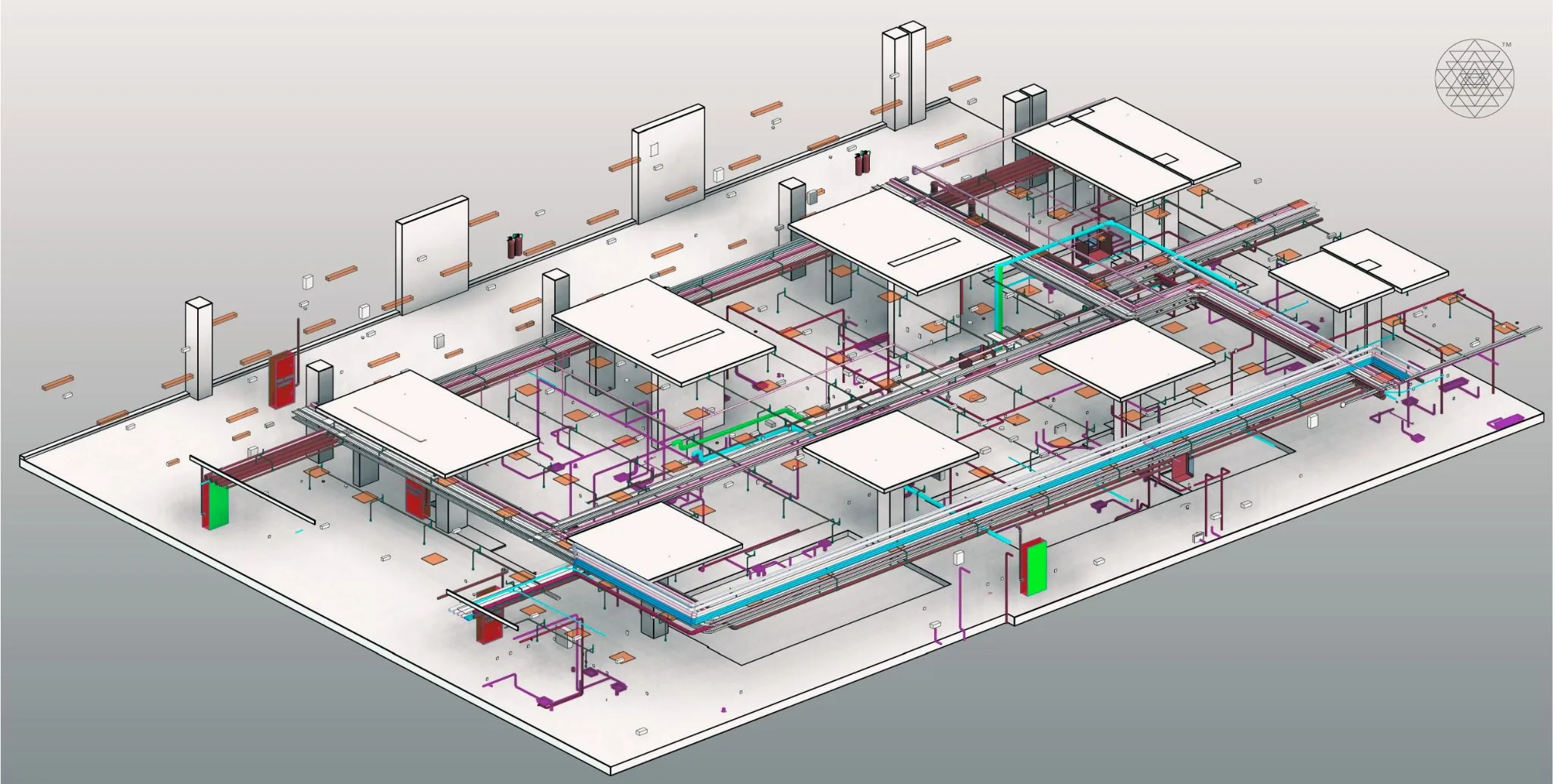
Our team specialises in delivering high-quality MEP modeling solutions that integrate the latest advancements in Building Information Modeling (BIM) technology, specifically tailored for the mechanical, electrical, and plumbing (MEP) disciplines. Our MEP BIM services support project teams at every stage, from early-stage coordination through construction-ready Revit MEP modeling deliverables. Our comprehensive MEP BIM services and Revit MEP modeling capabilities ensure every project is delivered with precision, coordination, and full compliance with industry standards.
MEP BIM Modeling
Our MEP BIM services encompass the creation of accurate and detailed digital representations of MEP systems within a building project. By utilising industry-leading software tools and methodologies including Revit MEP modeling we ensure that every aspect of the MEP components is meticulously modeled, including HVAC (Heating, Ventilation, and Air Conditioning), electrical systems, plumbing fixtures, fire protection systems, and more. Our experienced team of MEP modeling professionals collaborates closely with architects, engineers, and contractors to develop precise 3D models that accurately reflect the design intent and facilitate effective coordination.
MEP BIM Coordination
Efficient coordination among the various MEP trades is crucial for the successful implementation of a construction project. Our MEP BIM services coordination team focuses on resolving clashes and conflicts that may arise during the design and construction phases. By utilising advanced clash detection tools and clash resolution workflows within our Revit MEP modeling environment, we identify and rectify clashes between MEP systems, structural elements, and architectural features. This proactive approach to MEP modeling minimises on-site conflicts, reduces rework, and enhances project efficiency, ultimately leading to cost and time savings.
What Our MEP BIM Services Cover
Our MEP BIM services are organized by discipline, so every system is modeled and coordinated by people who understand its specific requirements and clash risks.
HVAC / Mechanical
HVAC BIM modeling covers the ductwork, air handling units, VAV boxes, chillers, and piping systems that make up a building’s mechanical infrastructure. We model these components in Revit MEP to precise dimensions and routing paths, so ductwork and equipment placement are coordinated with structural and architectural elements before installation. This reduces field conflicts around ceiling space, shaft routing, and equipment access.
Electrical
Electrical BIM modeling covers cable tray, conduit runs, panels, transformers, lighting fixtures, and low-voltage systems within a building’s electrical infrastructure. Our team routes these elements in Revit MEP to avoid clashes with mechanical ductwork and plumbing lines, while keeping panel and equipment access clearances intact. Accurate electrical modeling also supports load calculations and circuiting documentation later in the project.
Plumbing
Plumbing BIM modeling covers sanitary and storm drainage, domestic water supply, venting, and gas piing systems throughout a building. We model pipe slopes, fixture connections, and riser locations in Revit MEP to confirm they’re buildable within available ceiling and wall space. This discipline-specific modeling catches slope and clearance conflicts that generic modeling often misses.
Fire Protection
Fire protection BIM modeling covers sprinkler systems, standpipes, fire pumps, and related piping required for life safety compliance. We coordinate sprinkler head layout and standpipe routing against ceiling grids, ductwork, and structural elements to avoid last-minute field changes. Fire protection modeling is cross-checked against NFPA requirements as part of our standard workflow.
Our Commitment to Excellence
At VARMINE BIM, we are committed to delivering MEP BIM services and coordination of the highest quality. Our team of skilled professionals combines extensive domain knowledge with cutting-edge Revit MEP modeling technology to meet the unique requirements of each project. By leveraging the power of MEP modeling and coordination, we strive to optimise construction processes, mitigate risks, and deliver successful projects that exceed client expectations.
Contact us today to learn more about how our MEP BIM services and coordination can add value to your construction project.
Level of Development (LOD) in MEP BIM Modeling
LOD defines how much detail and accuracy a BIM model contains at a given project stage, ranging from conceptual (LOD 100) to as-built (LOD 500). Matching the right LOD to each project phase keeps modeling effort focused on what the stage actually needs.
- LOD 100 — Conceptual massing. MEP systems are represented generically to support early space planning and feasibility discussions.
- LOD 200 — Approximate geometry. Systems are shown with approximate size, shape, location, and quantity, useful for design development and preliminary coordination.
- LOD 300 — Precise geometry. Components are modeled to accurate size, shape, and location, ready for construction document coordination.
- LOD 350 — Coordinated interfaces. Adds connections and interfaces between MEP systems and other trades, supporting detailed clash detection.
- LOD 400 — Fabrication-ready. Includes fabrication, assembly, and installation detail, used to produce shop and spool drawings.
- LOD 500 — As-built. Reflects the actual installed condition of MEP systems for facility management and future renovations.
We typically deliver Revit MEP modeling services at LOD 300–400 for construction coordination, and can extend to LOD 500 for as-built documentation on request.
Software & Standards We Follow
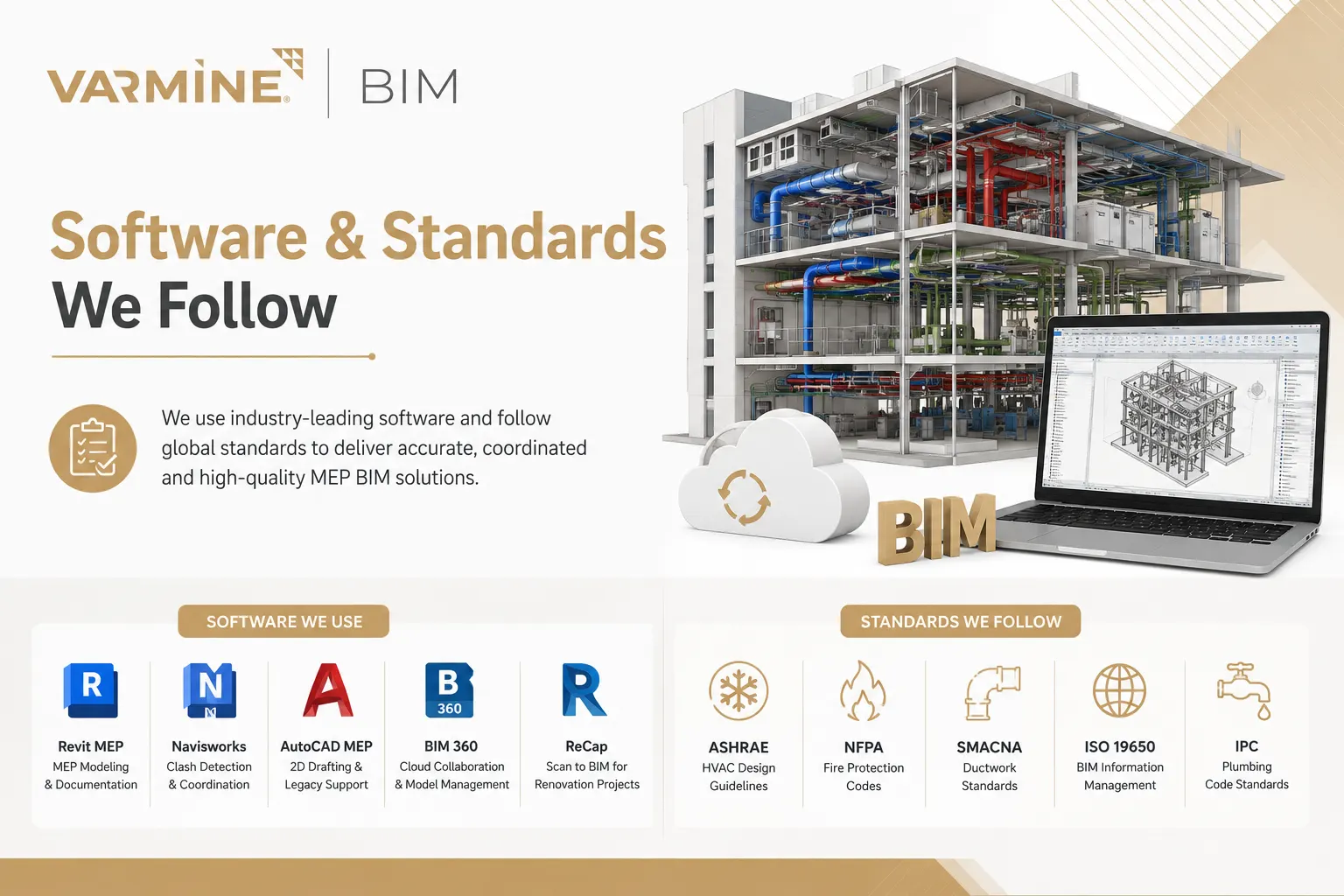
We build and coordinate MEP BIM models using an industry-standard software stack: Revit MEP for discipline-specific modeling, Navisworks for clash detection and coordination review, AutoCAD MEP for 2D drafting and legacy file compatibility, BIM 360 for cloud-based collaboration and model management, and ReCap for scan-to-BIM workflows on renovation and retrofit projects.
Our modeling and coordination work follows established industry standards, including ASHRAE guidelines for HVAC design, NFPA codes for fire protection systems, SMACNA standards for ductwork construction, ISO 19650 for BIM information management, and the IPC (International Plumbing Code) for plumbing systems.
Advantages of MEP BIM Modeling and Coordination
Implementing MEP BIM services and coordination offers numerous advantages throughout the lifecycle of a construction project. By leveraging this integrated MEP modeling approach, stakeholders can benefit from:
Enhanced Collaboration: Revit MEP modeling promotes seamless collaboration among project teams, allowing architects, engineers, and contractors to work together efficiently through a shared, coordinated model thereby minimising errors and rework across all disciplines.
Clash Detection and Resolution: Our MEP BIM services coordination enables the early identification of clashes and conflicts between MEP systems and other building components, preventing costly delays and modifications during construction. Revit MEP modeling clash detection workflows ensure issues are resolved before they reach the site.
Improved Design Visualization: With detailed 3D MEP modeling outputs, stakeholders can visualise and understand complex mechanical, electrical, and plumbing systems, making informed decisions and optimising space utilisation before construction begins.
Enhanced Construction Planning: Accurate MEP BIM services models facilitate better construction planning, leading to improved sequencing, coordination, and installation of MEP systems. Revit MEP modeling data ensures that every trade has the precise information needed to work efficiently on site.
Increased Efficiency: MEP modeling and coordination streamline construction workflows, improve productivity, and reduce construction waste, resulting in overall project efficiency. Our MEP BIM services approach ensures that every project benefits from reduced rework, faster delivery, and lower overall costs.
MEP BIM Deliverables
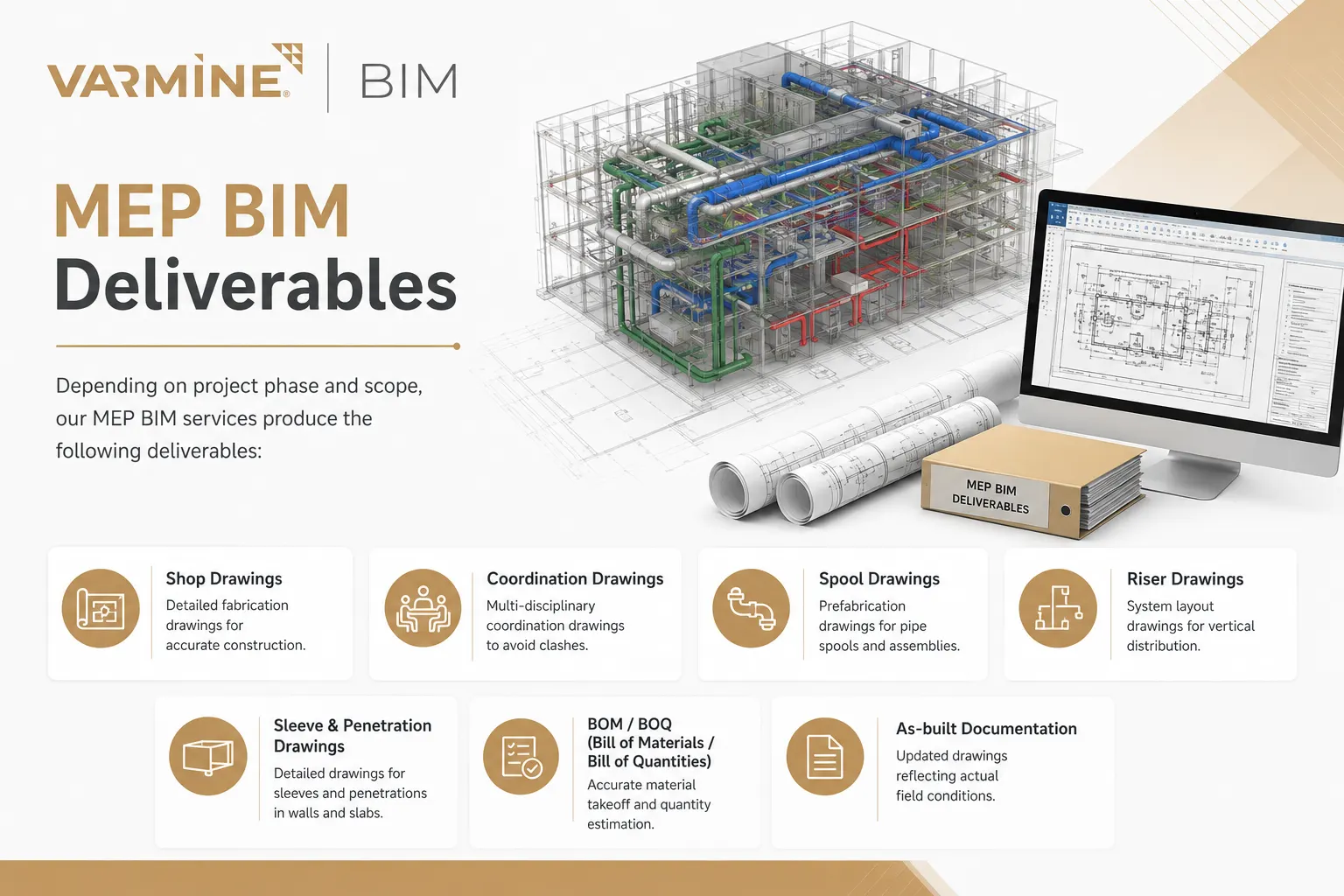
Depending on project phase and scope, our MEP BIM services produce the following deliverables:
- Shop drawings
- Coordination drawings
- Spool drawings
- Riser drawings
- Sleeve and penetration drawings
- BOM/BOQ (Bill of Materials / Bill of Quantities)
- As-built documentation
Our MEP BIM Modeling Process
- Project Intake & Scope Review — We review architectural and structural drawings, project requirements, and target LOD to define the scope of MEP modeling work.
- Discipline-Wise Modeling — Our team models HVAC, electrical, plumbing, and fire protection systems separately in Revit MEP, following the agreed LOD.
- Clash Detection & Coordination — Models are federated in Navisworks to identify and resolve clashes between MEP systems, structure, and architecture.
- Internal Quality Review — Coordinated models are checked against project standards, codes, and client requirements before delivery.
- Deliverable Production & Handoff — We generate shop drawings, coordination drawings, and other required deliverables, and hand off models and documentation to your team.
Industries We Serve
Commercial
MEP BIM modeling for office towers, retail, and mixed-use developments helps coordinate dense mechanical and electrical systems within tight ceiling plenums and shared risers.
Healthcare
Hospitals and clinics require precise MEP coordination for medical gas, HVAC redundancy, and infection-control airflow — areas where clash-free Revit MEP modeling directly affects patient safety.
Education
Schools and university buildings benefit from MEP BIM modeling that supports phased construction and future renovation flexibility without disrupting existing systems.
Residential
Multi-family and high-rise residential projects use MEP BIM services to coordinate compact mechanical and plumbing runs across repeated unit layouts.
Industrial
Manufacturing and warehouse facilities rely on MEP BIM modeling to coordinate heavy-duty HVAC, process piping, and electrical infrastructure around equipment and structural constraints.
Frequently Asked Questions
MEP BIM modeling is the process of creating detailed 3D digital models of a building’s mechanical, electrical, and plumbing systems using BIM software such as Revit MEP. These models represent HVAC, electrical, plumbing, and fire protection components to accurate size, location, and specification. They’re used for design coordination, clash detection, and construction documentation.
MEP BIM services refer to the broader scope of modeling, documentation, and support work across the MEP disciplines, while MEP BIM coordination specifically refers to identifying and resolving clashes between MEP systems and other building elements. Coordination is one component within the full range of MEP BIM services. Most projects require both: modeling to create the systems, and coordination to make sure they fit together without conflict.
We typically deliver Revit MEP modeling services at LOD 300 to LOD 400, depending on the project phase and client requirements. LOD 300 supports construction document coordination, while LOD 400 supports fabrication and shop drawing production. We can also model to LOD 500 for as-built documentation when needed.
We use Navisworks for clash detection and coordination review, alongside Revit MEP for modeling and BIM 360 for cloud-based collaboration. This combination lets us federate models from multiple disciplines and identify conflicts before construction begins.
Yes, we provide MEP BIM services to clients in the USA as well as internationally, including the UK, Canada, Europe, and other regions. Our workflows are built around remote collaboration, so project teams anywhere can work with us using Revit MEP, Navisworks, and BIM 360.
MEPF design refers to the mechanical, electrical, plumbing, and fire protection design of a building, covering the engineering decisions behind each system. MEP BIM modeling translates that MEPF design into a coordinated 3D digital model used for clash detection, documentation, and construction. In practice, MEPF design defines what needs to be built, and MEP BIM modeling defines how it fits together.